Rhinoplasty in Turkey : When you look in the mirror, what bothers you is sometimes not just the shape of your nose. The constant drifting of your attention to your nose in profile view, problems experienced while breathing, the lack of self-confidence felt when having photos taken, or a nose structure that is not in harmony with your face can over time affect a person’s social life and self-perception.
Thanks to today’s advanced surgical techniques, rhinoplasty surgery has gone beyond being merely an operation that changes the appearance of the nose; it has become a personalized application that appears natural in accordance with facial anatomy and preserves breathing functions. In particular, modern rhinoplasty procedures performed with closed rhinoplasty and ultrasonic piezo technology help the post-operative healing process to progress more comfortably while also making it possible to achieve natural results.
Closed ultrasonic rhinoplasty techniques applied by Op. Dr. Elad Azizli in Istanbul are among the modern surgical approaches that preserve facial proportions, are respectful of tissue, and are planned specifically to the patient’s needs.
What Is Rhinoplasty Surgery?
Rhinoplasty surgery, medically known as rhinoplasty; is a surgical procedure performed to regulate the shape, size, angles, and overall harmony of the nose with the face. However, in the modern understanding of rhinoplasty, the goal is not only to create an aesthetic appearance. Preserving the nose’s breathing functions, and even improving them when necessary, is also one of the important parts of the operation.
In past years, rhinoplasty operations were often planned based on standard templates, whereas today personalized surgical planning has come to the forefront. Because every facial structure is different. Standard procedures performed without evaluating skin thickness, bone structure, cartilage strength, facial proportions, forehead-nose-chin balance, and the person’s facial expression structure can lead to unnatural results.
For this reason, a successful rhinoplasty operation today does not only mean reducing the size of the nose. The main goal is; to create a nose structure that appears as if it belongs to the person’s face, does not draw attention, is natural, functional, and can maintain its form for many years.
In modern rhinoplasty applications, especially with the increasing expectation of a natural appearance, the concept of “nose design in harmony with the face” has come to the forefront. The majority of patients now want to stay away from sharp and artificial noses that are obviously operated on. Instead, results that preserve the person’s facial character, do not change their facial expressions, and increase their self-confidence in social life are preferred.
Why Is Rhinoplasty Surgery Needed?
Rhinoplasty surgery can come to the agenda for different reasons in each patient. While some people are bothered by a humped or crooked nose structure from birth, in some patients, deformations resulting from traumas, fractures, or previous operations can come to the forefront. In addition, breathing problems can also be quite influential in the decision for rhinoplasty.
The nose, which is located at the very center of the face, is one of the structures that directly affects the person’s overall facial expression. The disproportionate appearance of the nose with the face can cause the person to feel uncomfortable when having photos taken, to experience a loss of self-confidence in social environments, and over time lead to increased aesthetic concerns.
Common situations where rhinoplasty surgery is needed are as follows:
Nasal hump
Drooping nasal tip
Crooked nose structure
Large or wide nose appearance
Trauma-related deformities
Nasal asymmetry
Breathing problems
Septum deviation
Dissatisfaction with previous surgeries
Nasal tip deformity
Discomfort with profile appearance
However, the important point here is; that the person makes the surgery decision not only with aesthetic concerns, but with realistic expectations. A successful rhinoplasty operation should aim not for the person to look completely different, but for the face to look more balanced and natural.
Personalized Nose Analysis and Price Quote
Contact us for expert evaluation to find the most suitable method for you and clear price information.
One of the most important changes in the field of rhinoplasty today is the understanding of natural appearance. While more upturned, smaller, and attention-grabbing nose structures were popular in past years, the majority of patients now want natural results that do not make it obvious that they have had surgery.
In natural rhinoplasty, the goal is not to make the nose look beautiful on its own. The main target is; to ensure that the nose appears in harmony with the other anatomical structures of the face. Because after a successful rhinoplasty surgery, what should attract people’s attention is not the nose itself, but the overall balance of the face.
At this point, the surgeon’s facial analysis approach is of great importance. The forehead structure, lip-nose angle, chin projection, cheekbones, and the person’s skin structure must be evaluated in detail. Applying the same nose form to every patient can lead to moving away from natural results.
In rhinoplasty operations planned by Op. Dr. Elad Azizli, results that preserve the person’s facial character and support their natural facial expression structure are targeted. In particular, the application of tissue-preserving techniques through the closed rhinoplasty approach provides important advantages in achieving natural results.
What Is Closed Rhinoplasty?
Closed rhinoplasty is one of the modern surgical techniques in which rhinoplasty surgery is performed without making an externally visible incision. In this method, since all surgical procedures are performed from inside the nose, no externally visible surgical scar is formed.
The closed rhinoplasty method, which has been more frequently preferred by both patients and experienced rhinoplasty surgeons in recent years, stands out due to its tissue-preserving approach, more controlled healing process, and natural result advantages.
One of the most important advantages of closed rhinoplasty is that the nasal anatomy can be preserved more. Thanks to the reduction of surgical trauma, the amount of post-operative edema and bruising can progress more controllably in many patients. In addition, preserving the nasal support structures is also important in terms of the stability of long-term results.
The closed rhinoplasty technique is one of the operations that especially requires a high level of experience. Because the surgeon performs all procedures in a narrower working area. For this reason, the choice of doctor becomes much more critical at this point.
Op. Dr. Elad Azizli, who has been working in the field of rhinoplasty in Istanbul for many years, is among the experienced physicians who apply the closed rhinoplasty approach together with modern ultrasonic technologies in his operations.
What Is Ultrasonic Rhinoplasty?
Ultrasonic rhinoplasty is an advanced rhinoplasty method performed using piezo technology. In this technique, the nasal bones are precisely shaped with the help of ultrasonic devices instead of being broken in an uncontrolled manner as in classical methods.
One of the most important advantages of piezo technology is the minimum trauma given to surrounding soft tissues. Thus, while bone shaping procedures can be performed more controllably, the amount of post-operative bruising and edema can also progress at more comfortable levels in many patients.
Especially in patients with prominent bone structure, ultrasonic rhinoplasty technology provides the surgeon with a very precise working opportunity. Being able to create more controlled transitions while preserving the natural anatomy of the nose plays an important role in achieving a natural appearance.
In the modern rhinoplasty understanding, not only reducing the size of the nose but also preserving the harmonious transitions with the face and supporting the functional structure of the nose are targeted. For this reason, ultrasonic technology holds an important place in today’s advanced rhinoplasty applications.
What Are Letdown and Pushdown Rhinoplasty Techniques?
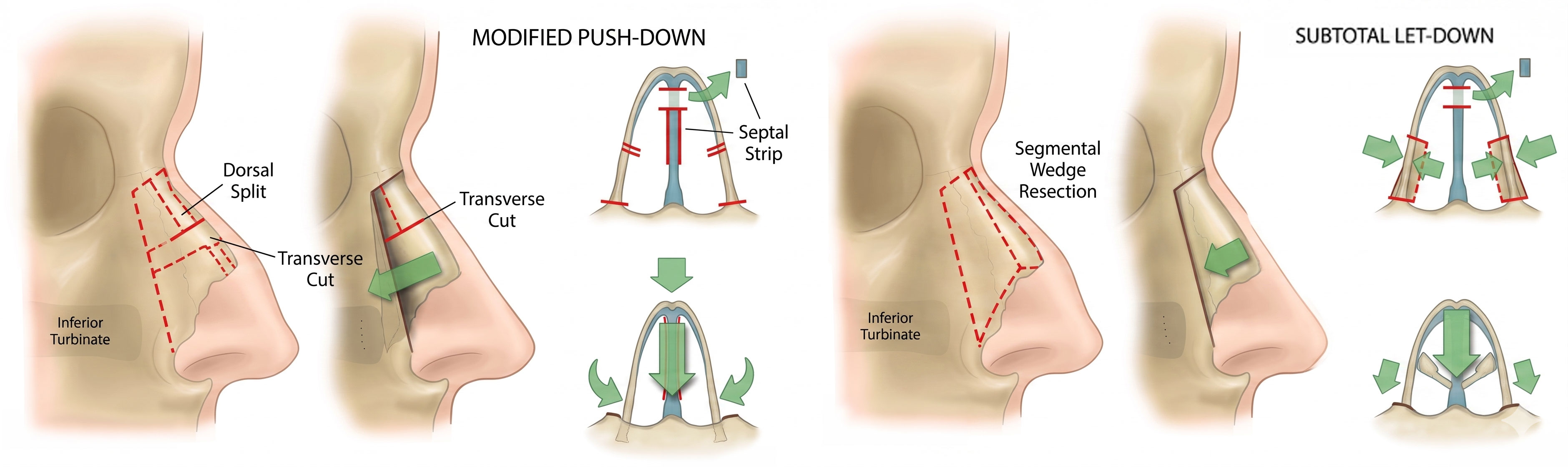
One of the most noteworthy developments in the field of rhinoplasty in recent years is the “preservation rhinoplasty” approach. Letdown and Pushdown rhinoplasty techniques are also among the important parts of this modern approach. The main purpose of these techniques is to achieve more natural transitions by preserving the natural anatomical structure of the nose as much as possible.
While in classical rhinoplasty operations the nasal dorsum is completely removed and reshaped in some cases, in preservation rhinoplasty techniques, priority is given to preserving the existing structure. Especially in patients with a nasal hump, preserving the natural nasal line can help achieve results that are more compatible with the face and whose surgical nature is not apparent from the outside.
In the Pushdown technique, the nasal dorsum is lowered in a controlled manner, while in the Letdown technique, the bone structure is repositioned with a different surgical planning. Which method will be preferred is determined entirely based on the patient’s anatomy. Because not every nose structure is the same, and applying the same technique to every patient may not yield the correct result.
One of the most important advantages of these techniques is that the natural upper line of the nose can be preserved. In this way, softer transitions can be achieved especially in the profile view. In addition, thanks to the tissue-preserving approach, the healing process can also progress more controllably in many patients.
Op. Dr. Elad Azizli evaluates Letdown and Pushdown rhinoplasty techniques according to the patient’s needs; and creates a personalized surgical plan together with the closed ultrasonic rhinoplasty approach. This approach is one of the important parts of the modern rhinoplasty understanding that supports both the natural appearance expectation and the preservation of the functional structure.
What Should Be Considered When Choosing a Rhinoplasty Doctor?
One of the most important factors that ensures successful results in rhinoplasty surgery is choosing the right doctor. Because rhinoplasty is not only an operation that requires an aesthetic perspective. It is also a complex procedure that requires advanced anatomical knowledge, functional approach, surgical experience, and an understanding of facial aesthetics.
Especially since patients’ greatest expectation in recent years has been natural results, the doctor’s approach has become even more important. What is important in rhinoplasty is not that the nose looks beautiful on its own; but that it is in complete harmony with the face. For this reason, the doctor needs to evaluate each patient according to their personal anatomical characteristics.
Some of the important criteria to consider when choosing a doctor are as follows:
Since rhinoplasty operations are procedures that can affect the person both physically and psychologically, the communication between the patient and the doctor is also very important. The patient’s ability to comfortably express their expectations and being correctly informed about the operation process increases the sense of trust.
At this point, Op. Dr. Elad Azizli stands out with his more than 10 years of rhinoplasty experience and modern surgical approach. His focus especially on closed ultrasonic rhinoplasty techniques and his patient-specific planning approach offer important advantages for patients with natural result expectations.
The Importance of European Board Certification in Rhinoplasty
Many patients planning rhinoplasty surgery may focus only on social media images when researching doctors. However, in advanced surgical procedures such as rhinoplasty, the doctor’s academic background, international qualifications, and surgical standards are also of great importance.
The European Board of Otolaryngology, Head and Neck Surgery certificate; is one of the important international certifications representing advanced knowledge, surgical competence, and academic equipment at European standards. Holding this certificate shows that the physician has successfully completed certain professional competence criteria.
Especially in complex operations such as functional nasal surgery and rhinoplasty, the anatomical approach is of great importance. Not only the external appearance of the nose, but also the breathing functions need to be preserved. For this reason, having a background in ear, nose, throat, and head-neck surgery can provide important advantages in rhinoplasty.
Op. Dr. Elad Azizli, who works in the field of rhinoplasty in Istanbul, is one of the few physicians holding the European Board of Otolaryngology, Head and Neck Surgery certificate. Evaluating both the aesthetic appearance and the functional structure together in his surgical approach constitutes an important advantage especially for patients with natural and long-term result expectations.
How Should the Decision for Rhinoplasty Surgery Be Made?
The decision for rhinoplasty surgery is not only a physical change for many people. This process is also closely related to the person’s desire to feel better about themselves. However, it is very important that the rhinoplasty decision is made not hastily, but in line with realistic expectations.
First of all, the person needs to be able to clearly define the points that bother them. While some patients are only bothered by the profile appearance, in some people breathing problems may be in the foreground. In addition, past traumas or dissatisfaction with previous surgeries can also be influential in the rhinoplasty decision.
The important point here is that the surgery should not be viewed as a “miraculous” procedure that will change the person’s entire life. Successful rhinoplasty operations do not transform the person into a completely different individual. But they can create a more harmonious appearance with the face, increase the person’s self-confidence, and help them feel more comfortable in social life.
In the correct decision-making process, it is important that the patient can clearly answer the following questions:
Which part of my nose structure bothers me?
Do I have a realistic expectation?
Do I want a natural result?
Am I ready for the healing process?
Do I trust my doctor?
Am I ready for the psychological effects of the operation?
Doctor-patient communication in rhinoplasty operations is very valuable for this reason. Correctly understanding the patient’s expectations and clearly explaining the surgically possible results can directly affect surgery satisfaction.
Pre-Operative Process for Rhinoplasty Surgery
The preparation process before rhinoplasty surgery is one of the important stages that affects the success of the operation. In this process, not only the shape of the nose but also the skin structure, breathing functions, facial proportions, and the patient’s general health condition are evaluated together.
At the first examination, the patient’s expectations are listened to in detail. While the existing anatomical structure of the nose is examined, the proportions with the face are also evaluated. Because applying the same nose shape to every patient may not produce natural results.
The following assessments may be made during surgical planning:
Before the operation, smoking, regular medications, and chronic diseases must also be evaluated. In particular, since smoking can negatively affect tissue healing, quitting before surgery may be recommended.
One of the biggest concerns of many patients is pain and fear of surgery. However, thanks to modern closed ultrasonic rhinoplasty techniques, the post-operative process can progress much more comfortably compared to past years.
How Does the Hospital Process of Rhinoplasty Surgery Proceed?
The surgery day process is one of the topics that patients planning rhinoplasty surgery are most curious about. Especially for people who have not previously undergone a surgical operation, the hospital process can sometimes seem stressful. However, in modern rhinoplasty applications, the process is generally planned in a way that prioritizes the patient’s comfort.
On the day of the operation, the patient first completes hospital admission procedures and then anesthesia evaluation is carried out. Rhinoplasty surgeries are most commonly performed under general anesthesia. Thus, the patient does not feel any pain or discomfort during the operation.
Although the duration of surgery may vary depending on the procedures to be performed, it may take an average of 2 to 5 hours. Primary rhinoplasty operations generally take shorter time; while in situations requiring advanced anatomical intervention or in revision rhinoplasties, the operation time may be extended.
In the closed ultrasonic rhinoplasty approach, precise work aimed at preserving the natural anatomical structure of the nose is performed throughout the operation. In particular, thanks to the use of piezo technology, bone shaping procedures can be performed in a more controlled manner.
After the operation, the patient is generally kept under observation for a few hours. Most patients can be discharged on the same day or the next day. Since much more comfortable tampon systems are used in modern rhinoplasty applications compared to past years, the patients’ post-operative experience has also changed noticeably.
The intense pain that many patients fear progresses more mildly than expected in modern techniques. Patients most often talk about a feeling of fullness in the nose and mild pressure rather than pain.
The First Week After Rhinoplasty
The first week after surgery is one of the periods that must be passed most carefully in the healing process. During this period, edema, mild bruising, and a feeling of fullness in the nose are considered normal.
In the first days, keeping the head elevated is especially important for edema control. Patients need to avoid heavy physical activities and pay attention to the care process recommended by the doctor.
In closed ultrasonic rhinoplasty techniques, since the surrounding tissues can be preserved more controllably, the amount of bruising and swelling in many patients can progress more mildly compared to classical methods. However, every patient’s healing process is different. Skin structure, lymphatic system, smoking, and the scope of the operation can affect the healing speed.
The following may generally be observed during the first week:
Nasal congestion feeling
Mild aching or pressure feeling
Edema around the eyes
Bruising
Sensitivity at the nasal tip
Feeling of fatigue
Being patient during this process is very important. Because the edema formed in the first days after surgery can hide the real shape of the nose.
1st Month After Rhinoplasty
At the end of the first month, the majority of patients can comfortably return to their social life. Although a significant part of the edema begins to decrease, mild swelling may continue especially at the tip of the nose.
Many patients notice during this period that their nose is gradually starting to look more natural. However, it should not be forgotten that healing in rhinoplasty is a process that extends over time.
The following are important points to be careful about during the first month:
Protecting the nose from impacts
Avoiding heavy sports activities
Being careful about eyeglass use
Not missing regular check-ups
Staying away from smoking
Healing can be observed more quickly especially in patients with thin skin structure, while resolution of edema may take longer in patients with thick skin.
3rd Month After Rhinoplasty
The third month is one of the periods when the new form of the nose begins to become more defined. A significant part of the edema has decreased and the harmony between the face and nose begins to be seen more clearly.
During this period, patients often begin to receive comments from their surroundings such as “looking more vibrant,” “more balanced,” or “it suits your face very well.” This is one of the most important features of successful rhinoplasty operations; that people notice the overall harmony of the face rather than the surgery directly.
One of the advantages of closed rhinoplasty and preservation techniques is that natural transitions can form more softly. Especially in patients where the Letdown-Pushdown approach is used, the natural lines in the profile view can be noteworthy.
6th Month After Rhinoplasty
By the sixth month, the overall form of the nose begins to emerge to a large extent. The balance between especially the nasal dorsum, nasal tip, and facial proportions can be seen much more clearly.
The majority of patients begin to feel a significant difference with their pre-operative photos during this period. However, it should not be forgotten that complete healing in rhinoplasty operations can vary from person to person.
Especially in patients with thick skin, the resolution of nasal tip edema may take longer. For this reason, being patient during the rhinoplasty process and not evaluating the final shape of the nose in the early period is necessary.
1 Year After Rhinoplasty
In rhinoplasty surgeries, the final result generally emerges within 1 year. During this process, the tissues of the nose heal completely, edema largely resolves, and the nose achieves complete harmony with the face.
After a successful rhinoplasty operation, the goal is not for the nose to draw attention, but for the face to look natural. The majority of patients express during this period that the lack of self-confidence they felt before the operation has decreased.
Especially in the natural rhinoplasty approach, the aim is not to change the person’s facial character; but to create a more balanced, more harmonious, and more aesthetic appearance.
What Should Be Considered After Rhinoplasty Surgery?
The care process after rhinoplasty is as important as the surgery itself. Paying attention to the doctor’s recommendations can directly affect the healing process.
The following are important points to be careful about after surgery:
Heavy exercises should be avoided in the first weeks
The nose should be protected from impacts
Lying face down should be avoided
Smoking should be avoided
Doctor’s recommendations regarding eyeglass use should be followed
Salt consumption may be limited
Regular check-ups should not be missed
Facial expressions that strain the nose should be avoided
It should especially not be forgotten that the healing process of the nose continues in the first months. For this reason, being patient and evaluating the final shape of the nose over time is necessary.
Why Choose Turkey for Rhinoplasty?
Turkey has become one of the destinations considered by international patients researching rhinoplasty, particularly those looking for an experienced surgeon, modern surgical techniques and a treatment plan that combines aesthetic and functional considerations. However, choosing to have rhinoplasty in Turkey should not be based on price or destination alone. The surgeon’s qualifications, experience in nasal surgery, hospital standards, surgical planning and postoperative follow-up are much more important factors.
For the right patient and with the right medical team, Turkey can provide access to experienced rhinoplasty surgeons, advanced surgical technologies and internationally oriented healthcare services within a well-established medical tourism environment.
Extensive Experience With Rhinoplasty
One of the main reasons patients consider a nose job in Turkey is the high level of clinical exposure to rhinoplasty procedures.
According to the International Society of Aesthetic Plastic Surgery (ISAPS) 2024 Global Survey, an estimated 60,982 rhinoplasty procedures were performed in Türkiye during 2024, making rhinoplasty the most frequently reported aesthetic surgical procedure in the country within the survey.
A high volume of procedures does not automatically mean that every surgeon or clinic provides the same level of care. However, it demonstrates the significant role rhinoplasty plays within Turkey’s aesthetic surgery landscape.
For patients, the more important question is therefore not simply “Why Turkey?” but:
“Which surgeon in Turkey has the training, experience and surgical approach appropriate for my nose?”
This distinction is particularly important in complex primary rhinoplasty, revision surgery and cases where breathing function must be considered together with appearance.
Access to Surgeons Focused on Both Appearance and Nasal Function
Rhinoplasty is more complex than simply making the nose smaller or changing its profile. The nose is both an aesthetic structure and an important part of the respiratory system.
A properly planned operation should therefore evaluate factors such as:
nasal bone and cartilage structure
skin thickness
nasal tip support
septal anatomy
nasal airway
facial proportions
previous trauma or surgery
the patient’s individual aesthetic expectations
This is why the surgeon’s medical background matters.
For patients researching rhinoplasty in Istanbul, choosing a surgeon who understands both nasal aesthetics and functional anatomy may be particularly important when nasal obstruction, septal deviation or previous nasal surgery is also present.
Modern Rhinoplasty Techniques Are Available in Turkey
Another reason Turkey attracts international rhinoplasty patients is access to contemporary surgical approaches.
Depending on the patient’s anatomy and the surgeon’s assessment, techniques may include:
closed rhinoplasty
ultrasonic or Piezo-assisted rhinoplasty
preservation rhinoplasty
Letdown and Pushdown techniques
structural rhinoplasty
functional nasal surgery
revision rhinoplasty
The availability of an advanced technique, however, does not mean that it is automatically the best option for every patient.
Modern rhinoplasty should be anatomy-driven rather than technique-driven. A responsible surgeon chooses the surgical method according to the patient’s nasal structure, functional needs and desired outcome rather than applying the same technique to everyone.
Personalized and Natural-Looking Results
International patients increasingly search for natural rhinoplasty in Turkey rather than an obviously operated or standardized nose.
Modern facial analysis considers the relationship between the nose and other facial structures, including the forehead, lips, chin, cheekbones and overall facial proportions.
The goal is not necessarily to create a “perfect nose” according to a fixed template. Instead, surgery can be planned to create a nose that looks proportionate to the patient’s individual facial anatomy while preserving their identity.
This is especially important because two patients asking for a similar change may require completely different surgical plans.
Skin thickness, cartilage strength, facial dimensions, nasal projection and breathing function can all influence what can realistically and safely be achieved.
Cost Can Be More Accessible, but It Should Not Be the Main Decision Factor
The cost of rhinoplasty in Turkey is another reason many international patients include the country in their research.
Treatment prices may be lower than those commonly encountered in countries such as the United Kingdom or the United States. Differences in healthcare operating costs, hospital expenses, professional fees and local economic conditions can all influence the final price.
However, patients should be cautious about choosing surgery based solely on the lowest quotation.
A rhinoplasty price should always be evaluated together with questions such as:
Who will perform the surgery?
What are the surgeon’s qualifications?
Where will the operation take place?
What does the quoted price include?
Are hospital and anesthesia fees included?
How is postoperative care organized?
What happens if an unexpected problem develops?
How will follow-up continue after returning home?
A lower price is only meaningful when appropriate medical standards, surgeon expertise and postoperative care are maintained.
Istanbul,Turkey Is Well Established for International Patients
Istanbul,Turkey has developed an extensive healthcare infrastructure serving both domestic and international patients.
For someone travelling from abroad, the treatment journey involves much more than the operation itself. Communication before arrival, consultation planning, hospital organization, postoperative examinations and instructions for returning home all contribute to the overall experience.
International patients should therefore evaluate not only the surgeon’s surgical ability but also how clearly the entire treatment process is explained.
Before travelling for rhinoplasty, patients should know:
how the initial consultation will be performed
how many days they should remain in Istanbul
when postoperative examinations will take place
when the nasal splint will be removed
when flying is considered appropriate
how follow-up will continue after returning home
Having this information before booking travel can make the treatment process considerably more predictable.
Rhinoplasty in Turkey With Dr. Elad Azizli
For patients considering rhinoplasty in Istanbul, Dr. Elad Azizli evaluates the aesthetic appearance of the nose together with its functional anatomy.
Dr. Azizli completed his specialist training in Otolaryngology – Head and Neck Surgery in 2013 and passed the European Board of Otolaryngology – Head and Neck Surgery examination. In 2024, he also passed the European Board Examination in Facial Plastic and Reconstructive Surgery organized by the European Academy of Facial Plastic Surgery (EAFPS).
His rhinoplasty practice includes closed rhinoplasty, structural nasal surgery, functional nasal reconstruction and revision rhinoplasty. Surgical planning is performed individually according to the patient’s anatomy rather than using a standardized nose design.
For international patients, the initial evaluation also provides an opportunity to discuss expectations, nasal structure, breathing problems, previous surgery where applicable and the most appropriate surgical approach before making a final treatment decision.
Is Turkey the Right Choice for Everyone Considering Rhinoplasty?
Not necessarily.
Choosing Turkey for rhinoplasty should be an individual medical decision rather than simply a response to lower prices or social-media trends.
Patients should compare surgeons carefully, verify professional qualifications, understand the proposed surgical technique and receive clear information about risks, recovery and follow-up before deciding to travel.
It is also important to remember that no surgeon can guarantee a specific aesthetic result. Healing varies between patients, and factors such as skin thickness, cartilage structure, previous surgery and individual tissue response can influence the final outcome.
For this reason, the best reason to choose Turkey for rhinoplasty is not simply that surgery may cost less. It is the possibility of finding an appropriately qualified surgeon whose experience, surgical philosophy and treatment plan match the patient’s individual needs.
Rhinoplasty Turkey Cost
Rhinoplasty Cost; can vary depending on many factors such as the surgical technique to be applied, the scope of the operation, the doctor’s experience, the technologies used, and whether the surgery is primary or revision. In particular, operations using advanced technology such as closed ultrasonic rhinoplasty can be evaluated in different price ranges than standard rhinoplasty applications, as they require personalized planning. Rhinoplasty operations performed in Istanbul; can offer important advantages in terms of both advanced surgical technology and access to experienced surgeons compared to countries such as Europe, the United Kingdom, and America.
2026 Current Price Comparison
Rhinoplasty Cost 2026
Rhinoplasty prices; can vary depending on the surgical technique used, doctor experience, hospital standard, scope of the operation, and whether the rhinoplasty is primary or revision. In Turkey, advanced techniques such as closed ultrasonic rhinoplasty and Letdown-Pushdown can be offered at more advantageous price ranges compared to Europe and America.
In modern closed ultrasonic rhinoplasty techniques, the post-operative period can progress much more comfortably compared to previous years. Patients generally describe a mild feeling of pressure rather than intense pain.
What is the difference between closed rhinoplasty and open rhinoplasty?
In closed rhinoplasty, all incisions are made inside the nose, and no visible external scars are formed. Furthermore, thanks to the tissue-preserving approach, the healing process can progress in a more controlled manner.
Is ultrasonic rhinoplasty advantageous?
Thanks to Piezo technology, bone shaping procedures can be performed with greater precision. This situation can help protect surrounding tissues and support a more controlled healing process.
Will there be any breathing problems after rhinoplasty?
In correctly planned rhinoplasty operations, the goal is not only an aesthetic appearance but also the preservation of breathing functions.
When does swelling go down after rhinoplasty?
Most of the edema decreases in the first months. However, for the nose to take its full shape, it can vary between 6 months and 1 year depending on the person.
At what age can rhinoplasty surgery be performed?
Generally, rhinoplasty is planned after the period when bone development is complete. This process may vary depending on the individual.
Does the nose droop after rhinoplasty?
In operations planned with correct techniques and strong cartilage support, the long-term preservation of the nasal structure is aimed.
Will there be any scarring after rhinoplasty?
In the closed rhinoplasty technique, since the operation is performed from inside the nose, no visible external incision scars are formed.
Rhinoplasty in Turkey : When you look in the mirror, what bothers you is sometimes not just the shape of your nose. The constant drifting of your atte..
Closed rhinoplasty is a nose reshaping operation performed entirely through incisions hidden inside the nostrils, leaving no visible external scar. Us..
What is Letdown-Pushdown Rhinoplasty?
Letdown rhinoplasty (lowering) technique, which is one of the rhinoplasty applications, is a technique applied ..
Revision rhinoplasty is a secondary nose surgery performed to improve aesthetic or functional problems that remain or develop after a previous rhinopl..
Nose Tip Aesthetics
Since its existence, mankind has been searching for the answer to one of the oldest philosophical questions, “What is beautiful?”..
Septoplasty-Nasal Cartilage Curvature Surgery
Nasal congestion is when the air taken from the nose gets stuck in obstacles and cannot be sent to the ..
 Türkçe
 РУССКИЙ
 Spanish
 Français