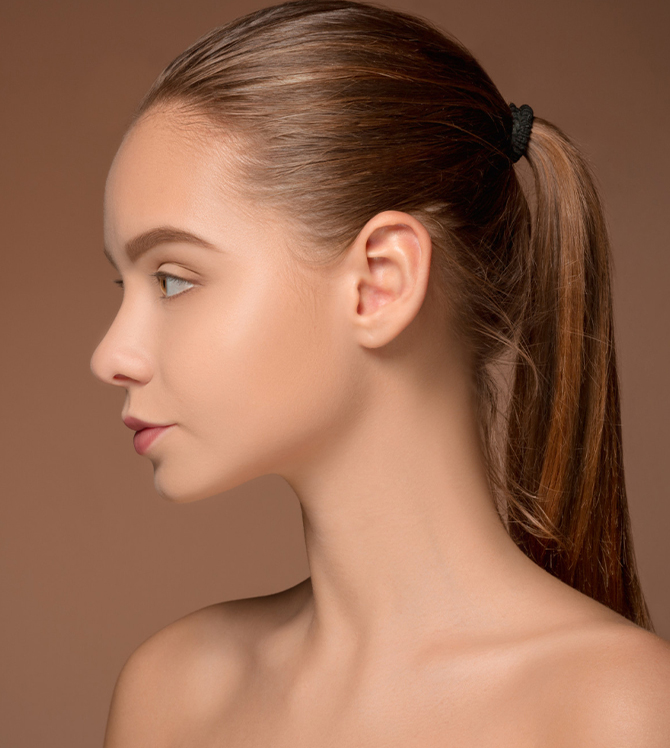
What Are Prominent Ears?
Prominent ears refer to a condition in which the external ears project more than normal from the sides of the head due to an increased ear–head angle or cartilage-related anatomical variations.
Otoplasty is the surgical procedure performed to correct prominent ears by reshaping the ear cartilage and restoring a natural, balanced ear position.
The ears play an essential role not only in hearing but also in facial symmetry and overall aesthetics. Prominent ears may negatively affect facial harmony and can lead to psychological distress, particularly during childhood.
Why Are Ears Important in Facial Aesthetics?
The external ear (auricle / pinna):
- Collects and directs sound waves into the ear canal
- Protects the middle and inner ear
- Contributes significantly to facial balance and symmetry
Under normal conditions, the distance between the outer ear and the head is approximately 1.5–2 cm, and the ear–head angle is around 20–25 degrees. Values beyond these limits may result in a prominent ear appearance.
Causes of Prominent Ears
Prominent ears are usually congenital and genetically inherited. The most common causes include:
- Underdevelopment of the antihelical fold
- Excessively soft or flexible ear cartilage
- Increased concha–mastoid angle
- Structural cartilage abnormalities
The condition may affect one or both ears.
Can Prominent Ears Correct Themselves?
No. Approximately 85% of ear development is completed by the age of 3, and full growth is achieved during adolescence. Once cartilage maturation is complete, prominent ears do not correct spontaneously.
What Is Otoplasty Surgery?
Otoplasty is a surgical procedure designed to reposition the ears closer to the head and reshape the cartilage to achieve a natural, symmetrical appearance.
How Is Otoplasty Performed?
Otoplasty typically involves:
- Hidden incisions behind the ear
- Cartilage reshaping or scoring techniques
- Adjustment of the ear–head angle
- Permanent suturing for stable correction
Anesthesia and Duration
- Children: General anesthesia
- Adults: Local or general anesthesia
- Surgery duration: Approximately 45–90 minutes
Ideal Age for Otoplasty
- Newborn period: Non-surgical ear molding may be effective
- 4–6 years: Ideal age for surgical correction
- Adults: Otoplasty can be safely performed at any age
Early treatment helps prevent psychological and social challenges.
Recovery After Otoplasty
- Same-day discharge
- Mild swelling and discomfort may occur
- Bandage for approximately 1 week
- Night headband for 2–4 weeks
- Return to daily activities within 5–7 days
Final ear shape becomes apparent within a few weeks.
Are Otoplasty Results Permanent?
Yes. The results of otoplasty are permanent, and the ears do not return to their previous position.
 Türkçe
 РУССКИЙ
 Spanish
 Français